Forrester’s PMI Example Shows EA Moving Into Delivery

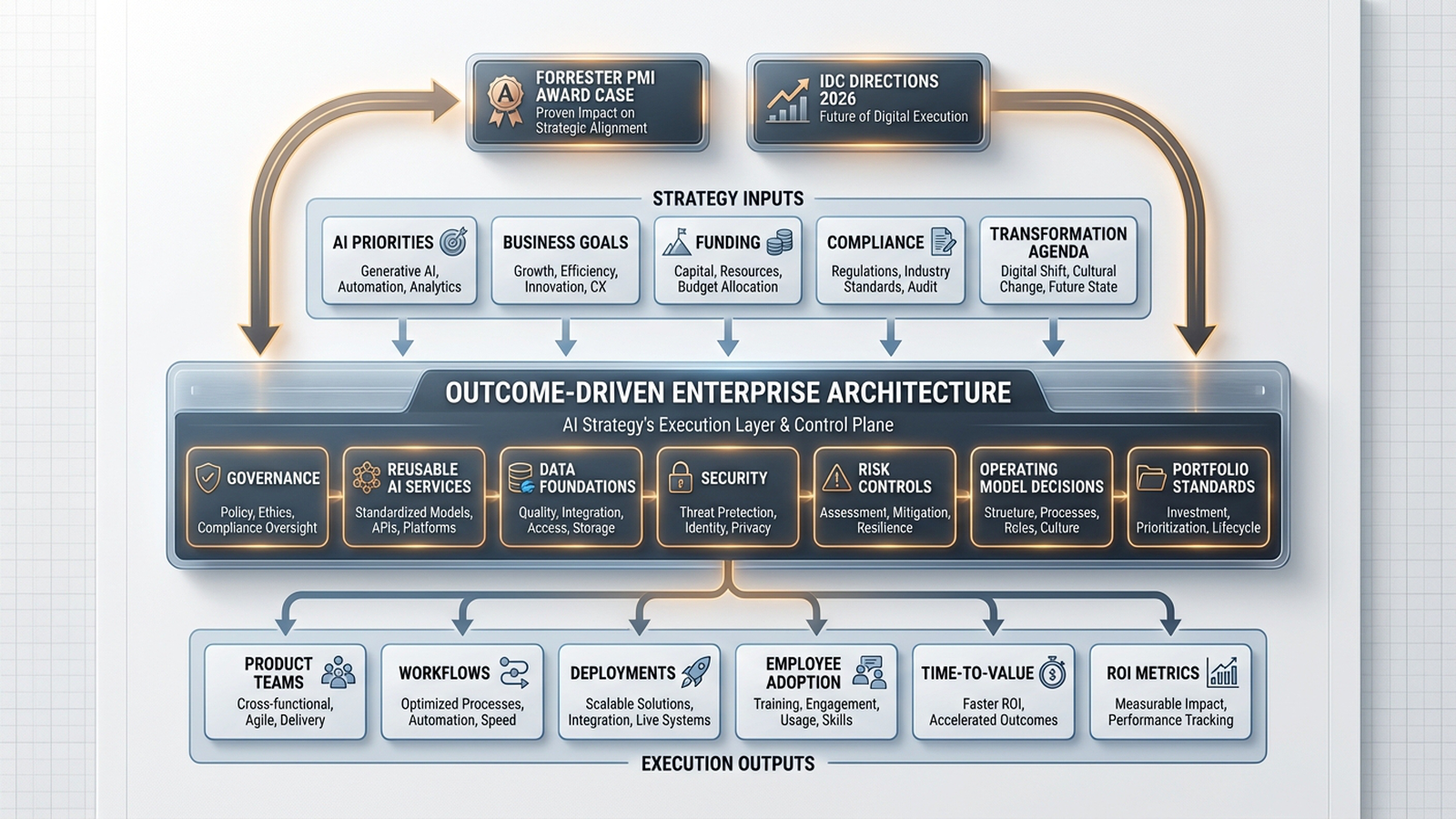
Forrester’s March 3, 2026 profile of Philip Morris International presents a concrete operating model, not a generic architecture success story. According to Forrester, PMI launched an AI Factory, deployed generative AI tools to 35,000 employees, and built more than 450 AI use cases across the enterprise. Forrester also says PMI’s Enterprise Architecture and Technology Transformation team redesigned its operating model so AI would be scalable, governed, and reusable from the start, framing the work as an example of Forrester’s Outcome-Driven Architecture model in practice.
The details matter. Forrester reports that PMI’s architecture team worked with legal, compliance, security, and strategy leaders to co-develop an AI governance framework with embedded guardrails and defined risk processes. It also says PMI strengthened its Trustworthy AI Framework in April 2025 and used the AI Factory to provide reusable, compliant AI components. In Forrester’s telling, PMI reports 40% faster time to value and 30% less development effort versus bespoke builds, while more than 65% of office-based staff regularly use the generative AI tools made available to them.
The interpretation is straightforward: architecture was not sitting outside the delivery motion. It was inside the mechanisms that made scale possible, including governance, reuse, operating model design, and adoption. That is a materially different role from enterprise architecture as a late-stage review board.
When architecture owns guardrails, reusable components, and adoption paths, it stops being a checkpoint and starts acting like an execution system.
IDC’s Message Is That AI Strategy Now Lives or Dies in Enterprise Execution

IDC’s March 5, 2026 post on Directions 2026 makes the enterprise execution challenge explicit. IDC says AI is no longer an experiment and describes the event as a forum for leaders moving from pilots to coordinated, enterprise-wide execution. The article warns that when AI initiatives scale without orchestration, infrastructure fragments, data governance lags, security gaps widen, and value becomes harder to prove. IDC’s framing is notable because it positions misalignment, not experimentation, as the central risk.
IDC also defines the domains leaders now have to connect. Its Directions 2026 agenda is organized around four decision areas: AI-ready infrastructure, emerging technologies, putting data to work, and marketing and business growth strategies. The article says trusted data foundations are required for AI value, and it explicitly ties autonomous execution to governance, event-driven architectures, data products, integration, and risk mitigation. Later in the piece, IDC states that enterprises turn AI investment into durable value by aligning infrastructure, trusted data, governance, security, and measurable business objectives before scaling initiatives.
IDC is not arguing that enterprise architecture is the only answer. But it is clearly describing an operating problem architecture is designed to solve: cross-domain coordination before scale. When architecture and oversight must be designed early rather than retrofitted after pilots, the center of gravity shifts from isolated AI use cases to enterprise execution design.
If AI scale depends on early alignment of infrastructure, data, governance, and business goals, execution becomes an architectural problem before it becomes a tooling problem.
Why Outcome-Driven EA Fits the AI Governance Moment
Taken together, the Forrester and IDC pieces converge on three requirements. First, governance has to be built before scale, not after it. Second, AI has to be industrialized through reuse rather than one-off delivery. Third, value has to be made visible in operating terms, whether that means time to value, development effort, adoption, or business impact. Those themes are explicit in Forrester’s PMI example and equally explicit in IDC’s description of what enterprises need in order to move from pilots to governed, value-producing systems.
This is why outcome-driven enterprise architecture looks increasingly relevant. Forrester’s Outcome-Driven Architecture model defines high-performing EA through attributes such as being valuable, accountable, influential, collaborative, agile, and innovative. In the AI context, those are not abstract virtues. They map directly to the work of creating governance guardrails, shaping reusable platforms, influencing funding and delivery choices, and tying technology decisions to measurable business outcomes.
What remains uncertain is whether every enterprise can replicate PMI’s operating model. Forrester highlights a standout case, not a market-wide benchmark, and IDC outlines the coordination challenge rather than prescribing a single organizational blueprint. The defensible conclusion is narrower but still important: as AI programs become more cross-functional and more governed, enterprise architecture is moving closer to the role of control plane for execution.
The more AI depends on shared guardrails and reusable platforms, the more outcome-driven enterprise architecture looks like the control plane for enterprise execution.
What CIOs, Architects, and Engineering Leaders Should Test Now
The practical next step is not to debate labels. It is to test whether governance and delivery are actually tied to measurable outcomes. Based on the supplied sources, four questions stand out. Is AI governance co-designed with legal, security, compliance, and strategy leaders, as Forrester describes at PMI? Is there a reusable component model, similar to the AI Factory concept, so teams assemble rather than repeatedly rebuild? Are data, infrastructure, and risk decisions being aligned before scale, as IDC argues they must be? And are leaders tracking outcome metrics that matter to the business, not just model or pilot activity?
If the answer to those questions is no, many organizations still have AI strategy without an execution layer. If the answer is yes, enterprise architecture may already be doing more than most organizations formally recognize. The point is not to expand EA’s mandate rhetorically. It is to verify whether architecture has real influence over the decisions that determine AI speed, safety, reuse, and business value.
The real test is whether architecture is connected to the metrics and decisions that determine AI scale, safety, and value.
Wrapping Up
Forrester’s PMI case and IDC Directions 2026 do not prove that every enterprise needs the same AI operating model. They do show something more useful: AI execution now depends on early governance, reusable architecture, trusted data, and outcome discipline. For CIOs, enterprise architects, and engineering leaders, the next move is less about writing another AI strategy document and more about determining whether enterprise architecture is connected to the platforms, guardrails, and metrics that make strategy executable. That is where AI ambition either compounds into enterprise value or stalls in pilot mode.
Sources & References
- How PMI’s Outcome‑Driven EA Practice Won the 2025 Forrester EA Award — Forrester
- IDC Directions 2026: Where AI Strategy Becomes Enterprise Execution — International Data Corporation